What Is the Light-gathering Power of an 8-inch Telescope Compared to a 4-inch Telescope?
ASTR 1210 (O'Connell) Study Guide
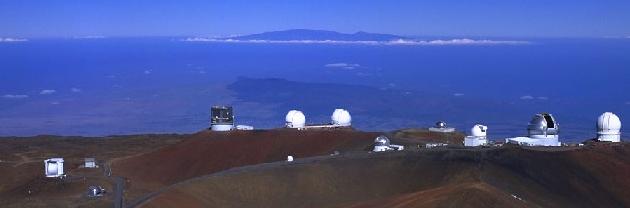
Summit of Mauna Kea, Hawaii
The telescope is the single well-nigh important invention for astronomy. It is a beautiful example of the interplay between engineering science (fabrication of quality glass, optics design, polishing techniques, big mechanical structures, computers) and basic scientific discipline.
This lecture describes the main features of optical-band telescopes---i.due east. those which operate in or nearly the part of the EM spectrum to which our optics are sensitive. This is the only kind of telescope which was in widespread utilize earlier 1950.
Since that time, astronomers have developed other types of "telescopes" to exploit a big role of the whole electromagnetic spectrum. Cosmic sources produce radiation across the entire range of this spectrum. Some telescopes for other spectral bands (e.chiliad. the ultraviolet and near-infrared) are quite similar to optical telescopes. Others (e.grand. for the radio and gamma-ray bands) use very unlike technologies.
A. Introduction
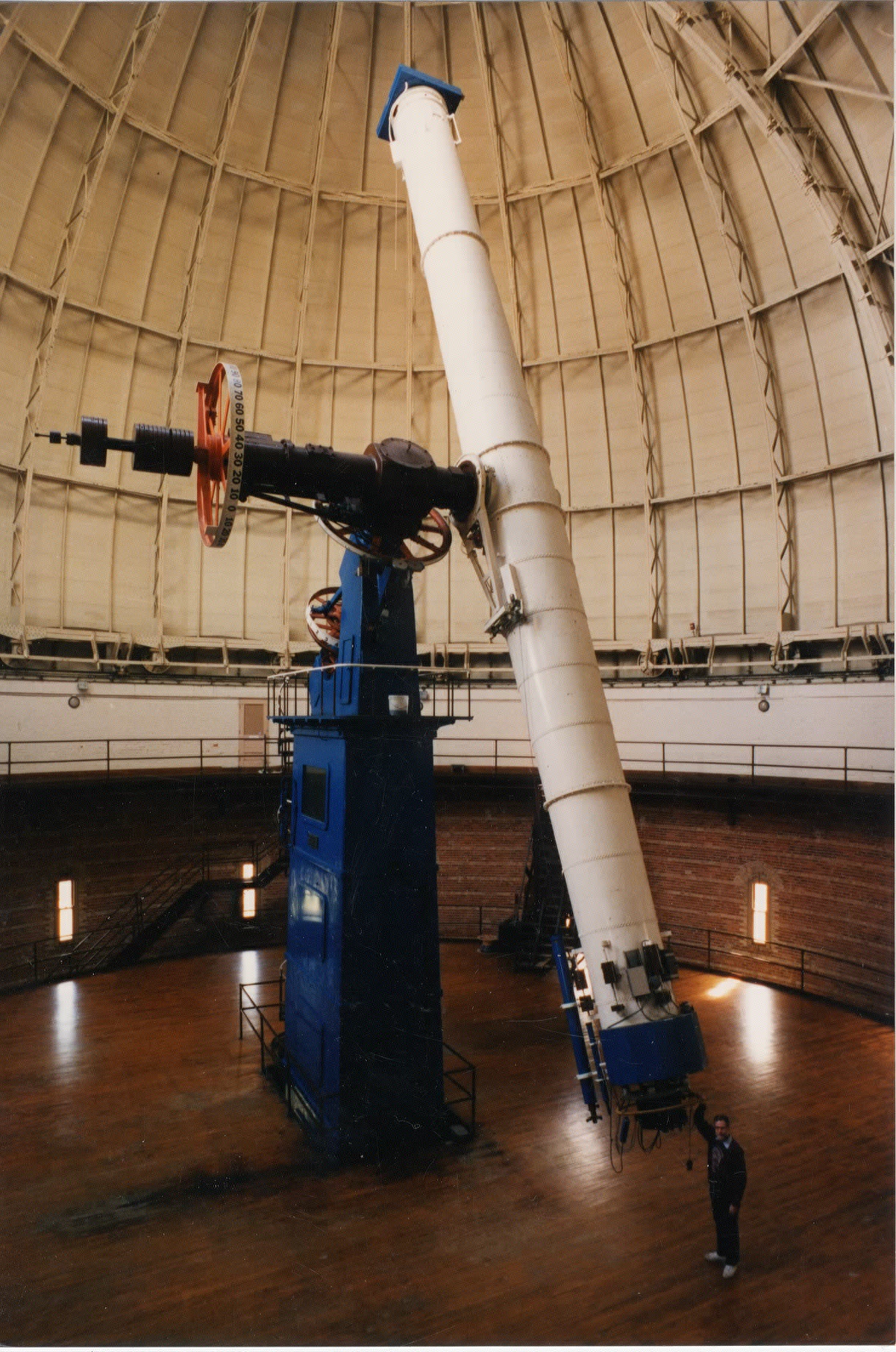 The telescope was invented in 1608 past Lipperhey in Holland.
- Although lenses had been used in eyeglasses for several centuries, realization of college precision optical devices suitable for viewing distant objects depended on improvements in lens-grinding technology. Details of the early on work of Lipperhey, Galileo, and others are given here. Note: the microscope was invented effectually 1620, likewise in The netherlands, and was responsible for opening up a 2d kind of "invisible world." Modern medicine would non exist without the microscope.
The showtime astronomical utilise of a telescope was by Galileo, in Italy in 1609. The telescope instantly and utterly transformed astronomy (see Study Guide 7).
Galileo'southward lenses were only about one inch in diameter and of relatively poor quality. But telescope technology had avant-garde over the subsequent 300 years to the point where the largest operating telescope in the year 1900 was the Yerkes Observatory 40-inch telescope shown at the right.
Purposes
- Collect more light: in order to detect fainter objects. This is the nearly important office of telescopes.
- Light gathering ability depends on the telescope diameter2
- Thus, a 10-in bore telescope collects (x/5)two = 2ii = 4 times every bit much light as a 5-in telescope.
- An 8-in telescope (widely used by amateur astronomers) collects 1600x more light than the human eye. Because there are many more faint stars than bright ones, an 8-in scope tin discover over 2000x as many stars (ten million compared to 5000) as the unaided centre.
- Resolve sources better: provide sharper images, permit seeing more detail. Resolution depends on both the diameter of the telescope and its optical quality
- Magnify sources: make the images of distance objects larger for easier study
B. Designs
Basic principle
- An objective or "chief" optical element forms an image (i.e. an accurate representation of the original scene) at a usable focus , where it can be studied past heart, recorded past moving-picture show or other detectors (as in a photographic camera), or fed into nevertheless other instruments The objective element tin can be either a lens or a mirror.
Types of telescopes
There are therefore two basic types of telescopes:
- Refracting telescopes : the objective is a lens (shaped, transparent glass) which refracts (or bends) incoming light rays to a common focus. The image at the left below shows how a flat glass surface bends light rays. In this case, two flat surfaces at a angle have been combined to brand a prism. The shorter the wavelength of the light, the stronger the angle.
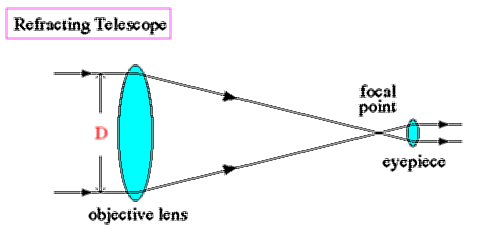
- The image at the right below shows how a drinking glass surface can be continuously curved to bring all the light rays passing through it from a given signal on a distant object to a common focal point . The largest refractor ever built was the Yerkes Observatory 40-in telescope (1896).
- Because refraction is stronger for shorter wavelengths, all lenses produce chromatic aberration, in which light of dissimilar wavelengths comes to a focus at unlike positions. Chemical compound lens designs can reduce only never eliminate the flaws in images that result.
- Reflecting telescopes : the objective is a shaped mirror coated with a metal movie, which reflects light rays off its front end surface to a common focus. Come across the moving-picture show below. Invented past Gregory (1663); improved past Newton (1669).
- Many early reflecting telescopes employed metal mirrors, simply most all modern designs utilise glass mirrors. At offset sight, a reflecting design is counterintuitive because the focus is in a position where placing equipment would interfere with the incoming light beam. This is true, only the effects, both in terms of blocking the calorie-free and diminishing the paradigm quality, are small if the mirror is large enough. Most reflecting telescopes use a "secondary" mirror to redirect the light beam outside the master body of the telescope. In that location are many different designs for reflecting systems, each with its own advantages and disadvantages. Reflecting designs have a number of advantages over refractors: There is no chromatic aberration. The mirror is easy to support from behind, different a lens which must be supported from its edges and tends to sag. Mirrors are figured on but one side, whereas lenses must be figured on both. It is harder to back up heavy lenses mechanically at the superlative end of a telescope tube than a mirror at the bottom terminate. Multiple mirrors tin can exist used to fold the light beam and reduce the length of a telescope tube. All big telescopes are therefore reflectors. The largest fully steerable reflector is the Gran Telescopio Canarias (409-in in diameter: built 2009). A telescope 1550-in (39.3-m) in diameter is now under construction at the European Southern Observatory.
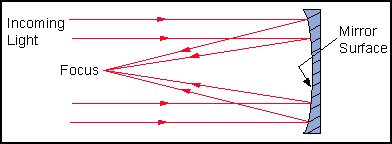
Reflection of Lite by a Figured Mirror -
 Applet. Here is a Java applet illustrating the differences between refraction, reflection, and diffraction.
Focal plane
- For distant objects (including all astronomical objects), the incoming rays are parallel to 1 another. Such rays are focussed in a plane which is i focal length from the objective. This is called the "focal plane." Click on the push below for a Coffee applet illustrating image formation for objects at different distances. Applet
- In the focal aeroplane, the low-cal rays from a distant object form a i-to-one representation of the distant scene which is called an image .
- Commonly, a photographic camera or other musical instrument in placed at the focal plane. For "visual" utilize of a telescope, an eyepiece (a smaller lens or combination of lenses) can exist used to magnify the focal airplane image and so it can be viewed by the eye. See the illustration higher up. The magnification of the image seen through the eyepiece is equal to the ratio of the focal length of the objective to the focal length of the eyepiece.
C. Image Quality
The crispness of images made by a telescope depends on several factors: fabrication of the eyes, the size of the telescope compared to the wavelength of light, and the Earth's atmosphere.
The "resolution" of a telescope image is quantitatively defined to be the smallest measurable detail in an image (in seconds of arc).
Optical Figuring
- Light is a moving ridge. In order to produce a expert image, telescope eyes must exist figured to a minimum tolerance of about 1/4 of the wavelength (distance betwixt crests) of the light they are intended to focus. For optical telescopes, this is about x-5 cm.
- The intended shape of an optical surface, e.thousand. the curve in the convex lenses shown to a higher place, must exist reproduced to high precision in social club to obtain good epitome quality.
- Scale comparison: if a 320-in (8-m) diameter telescope mirror were scaled upwardly to the size of the continental United States, i.e. nigh 3000 miles diameter, then the maximum ripple allowed in its polishing would be only about ii inches!
Diffraction
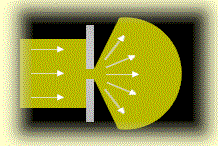
- A fundamental limit on resolution is fix by the physics of light. Since information technology is a wave miracle, light spreads out or diffracts when it passes through an discontinuity (like bounding main waves around a breakwater). This smears out images. Applet. Hither is a squeamish interactive Java applet illustrating diffraction.
- Diffraction is worse the longer the wavelength of low-cal and the smaller the telescope aperture. Click here for an illustration of how telescope size affects resolution.
- A 10-in diameter telescope with perfect optics can resolve ane arc-sec at optical wavelengths. A 100-in diameter telescope could resolve 0.1 arc-sec.
- Note that almost all stars are then afar that they are smaller in angular size than 0.ane arc-sec and therefore appear as point sources in such a telescope. Just a handful of stars can be resolved by even the largest telescopes.
"Seeing" Produced past Earth's Temper
"Seeing"
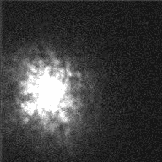
- The Globe's atmosphere also refracts light; and because information technology is constantly moving, at that place is always a blurring and jittering of images in a telescope. Astronomers phone call this "seeing." Seeing actually dominates diffraction in most cases and usually limits telescope resolution in practice to 0.5-2 arc-seconds.
- Above is an enlarged image of the vivid star Betelgeuse seen though a large telescope. It is a large hulk, broken up into smaller most betoken-similar units. Click on the image for a video of the seeing effects. In the absence of the atmosphere, the image would be steady with all of the light concentrated into 1 of those indicate-like structures.
- To overcome seeing effects, special equipment such as adaptive optics , which can sense and partially correct for atmospheric blurring, can be used. Or, telescopes can be placed in space (where there's no atmosphere), though this is much more costly.
Heaven Background
- The natural night sky in directions abroad from bright sources is not totally night. There are several kinds of pervasive, diffuse "groundwork" low-cal: scattered sunlight or moonlight in the Earth's atmosphere, airglow emission from the atmosphere's upper layers, scattered light from grit in the interplanetary and interstellar medium, and faint stars and galaxies. Sky background light does not mistiness images, but it certainly interferes with detection and report of faint sources (and at that place are many more faint sources than vivid ones). Compounding the natural background is manmade light pollution, a problem with which astronomers take wrestled for centuries. Initially, telescopes were built next to universities, ordinarily in or near cities. However, the growth of bogus light pollution drove telescope construction to ever more than remote sites, start in the southwestern US (due east.g. California, Texas, Arizona), and finally to high mountains like Mauna Kea in Hawaii or the northern deserts of Republic of chile. Ultimately, astronomers take placed telescopes in infinite to escape the effects of atmospheric backgrounds altogether (see next section).
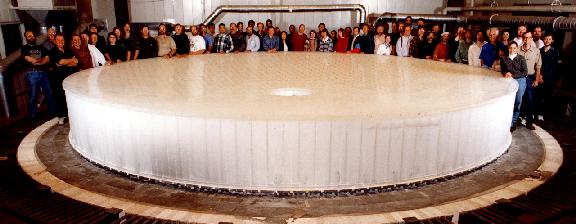
Mirror blank for ane of the 2 mirrors of the Large Binocular Telescope.
Click for enlargement.
D. Current Telescope Milestones
The Hubble Space Telescope: 94-in reflector in orbit around the Earth (launched 1990)
- HST is not a big telescope by modern standards. But it has produced the highest resolution images yet obtained at visible wavelengths, with blur sizes of only about 0.05 arc-seconds. This is because of its high quality eyes and the fact that information technology is outside the Globe'southward atmosphere, and then it does not have to contend with seeing or absorption or scattering by atmospheric constituents. Its high resolution and the absenteeism of the natural and bogus atmospheric background also allows it to observe very faint sources. Here is a composite version of some of HST's best images.
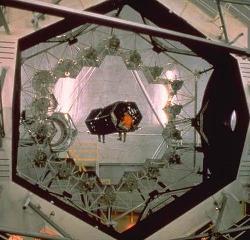 Keck Observatory: Two 400-in "segmented mirror" telescopes (1993, Hawaii). The collecting area of each consists of 36 independent 36-in hexagonal mirrors. Run into image at right and this diagram.
The Very Big Telescope (VLT): Four 320-in monolithic mirror telescopes (2001, Chile)
The Large Binocular Telescope: two 330-in (8.four-m) diameter monolithic mirrors on a common mount, providing the largest existing collecting area. One of the mirrors is shown above. UVa is a partner in this project.
Run into this graphical comparison of the collecting areas of the largest existing and planned telescopes.
Large mirror technology
- Here (from the Magellan Observatory) is a brief description of how the latest generation of huge telescope mirrors are manufactured:
- The Magellan main mirrors are f/ane.25 paraboloids and a radical divergence from the nearly solid-glass mirrors of the past. Each is 21,000 pounds of borosilicate drinking glass with a lightweight honeycomb construction within. It took 6 months to build the mold for each mirror, ii days to fill up information technology with chunks of drinking glass, 1 week to melt the glass and spin information technology into shape (in a specially designed rotating oven), and three months for the glass to cool. Each was and then polished for 8 months while its surface was constantly tested for accurateness. Relative to their size, the main mirrors are nearly equally sparse as a dime. The aluminum surface of each mirror is a mere four-millionths of an inch (0.1 micron) thick. Each also sits in a "cell" that peforms two of import functions. First, the cell'south thermal control systems prevent warping from thermal expansion and contraction. 2d, the support systems in the cells maintain the mirrors in their proper shape, then at that place is no distortion or cracking. The bodily shape of the mirror surface is controlled to within ii-millionths of an inch (0.05 microns).
Other EM spectral bands
- The telescopes we've discussed so far operate only in the optical (or "visible") and adjacent spectral bands, but astronomers now exploit most of the total electromagnetic spectrum to detect the creation. The first instruments outside the visible range were radio telescopes (1950'south). At present astronomers operate not only radio telescopes (e.g.the National Radio Astronomy Observatory, with headquarters in Charlottesville) just too microwave, infrared, ultraviolet, 10-ray, and gamma-ray telescopes. All of the devices for detecting EM waves are called "telescopes," fifty-fifty though some (e.yard. radio antennas) wait nothing similar classical optical telescopes. Because the Earth'due south temper screens out many parts of the the EM spectrum (see Study Guide x), telescopes for the gamma-ray, X-ray, ultraviolet, and parts of the infrared and microwave spectrum must be placed on spacecraft exterior the atmosphere.
E. Side by side Generation Telescopes
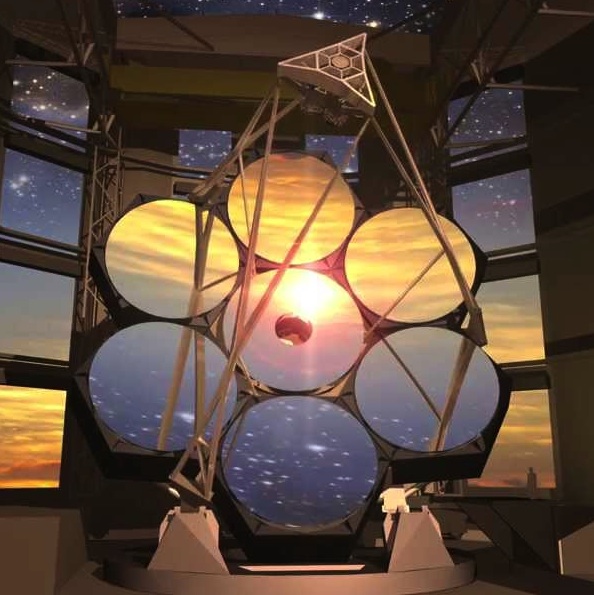 Two very large telescopes based on the segmented-mirror concept of Keck have been designed: the Xxx Meter Telescope and the European Extremely Large Telescope (39-meters or 1550-in). The ELT is now under construction in Republic of chile, but the TMT is embroiled in a dispute over environmental and cultural impacts at its preferred Mauna Kea site. The Behemothic Magellan Telescope (at right), also under construction in Chile, is a multiple-mirror design with vii 8.4-meter spin-cast mirrors and an equivalent collecting area of a single 22-meter mirror. The vi off-centrality segments are challenging to figure to the correct surface shape.
Another large telescope with a very unlike design and operations mode is the Big Synoptic Survey Telescope of the Vera C. Rubin Observatory. To reach a broad field of view (3.vo) information technology employs a unique 3-mirror design in which the principal and 3rd mirrors have been figured on a single piece of spin-cast drinking glass 8.4-meters in diameter. The telescope is intended to repeatedly image the unabridged usable sky every 3 nights, searching for transient or moving targets (including nearly-Earth asteroids) while building up an ultra-deep combined prototype of the sky. Continuous output from its 189 imaging CCDs (see below) will generate an unprecedented data volume (15 TB/night). Under construction in Chile, LSST should be in functioning past 2021.
The James Webb Infinite Telescope, expected to be launched in 2021, is the follow-on to HST. It features a 6.5-thou diameter main mirror (a 25 foursquare meter collecting area, 5.5 times that of HST) composed of 18 hexagonal segments that must be deployed on-orbit. JWST carries 4 imaging and spectroscopic instruments and is optimized for the about-infrared spectral region. A large sunshield permits a low overall structural operating temperature through cooling to space. JWST will orbit around the Globe-Dominicus Fifty2 point, about 900,000 km from Earth.
F. Detectors
The homo eye is a sophisticated, machine-focus, motorcar-exposure, electrical camera organisation. Still, for all its versatility and importance to u.s.a. in everyday life, it is a seriously limited astronomical detector: it is pocket-size, its maximum integration time is merely almost 0.1 sec, and information technology has low sensitivity. Astronomers accept long sought more capable detectors to use with telescopes. Descriptions of the two most important kind of imaging detectors are given next:
Photographic Film
- Film was the primary astronomical detector used between 1900 and 1980.
- Information technology detects only 1-two% of incident photons (not much better than the heart) but allows long integrations (hours)
- Requires chemic development of image later on exposure, a serious complication.
- Provides permanent storage of image information---a tremendous benefit. But data on film is not in digital class, which makes quantitative analysis hard.
- Extends the appreciable EM wavelength range to regions (the well-nigh-UV and virtually-IR) where the eye is not sensitive
- Large formats are possible (up to xx-in square for astronomy)
- Nonlinear, nonuniform response makes quantitative measures of incident light energy difficult
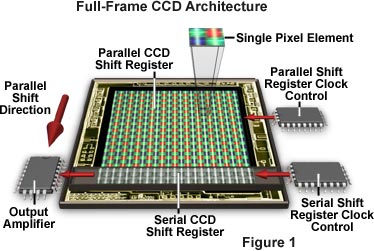
Charge-Coupled Device Architecture
"Charge-Coupled-Devices" (CCD's)
- CCD detectors are a blazon of solid state electronics, using a light-sensitive silicon wafer fabricated with embedded microelectronic integrated circuits by photolithography. .
- Run across paradigm above. The CCD surface is composed of millions of independent, light-sensitive pixels .
- After exposure, pixel contents are shifted in two dimensions across the surface to an output amplifier and storage device.
- Astronomical applications were pioneered during development of the Hubble Space Telescope (1974-85).
- CCDs piece of work well at both very short (Tv set) and very long (astronomy) exposure times.
- They are 50-100x more sensitive than picture show
- They provide digital image storage for immediate reckoner processing
- Conclusion of incident light energy is easier
- Only small-scale formats are available (2-in typical); only one can "mosaic" CCDs to create a big area detector surface
- The largest CCD mosaic camera, containing 201 CCD's, is existence built for the Large Synoptic Survey Telescope (see higher up).
- CCDs are now the standard detectors used in optical-ring astronomy.
CMOS solid state detectors, with characteristics like to CCDs, are employed in commercial still and video cameras and cell phones. These are mass-produced in quantities of billions. They are significantly less well suited to astronomical use (being harder to calibrate, for example), but astronomical applications are now being explored.
Many other types of electronic detectors are now used in the UV, IR, and Ten-Ray bands of the astronomical EM spectrum.
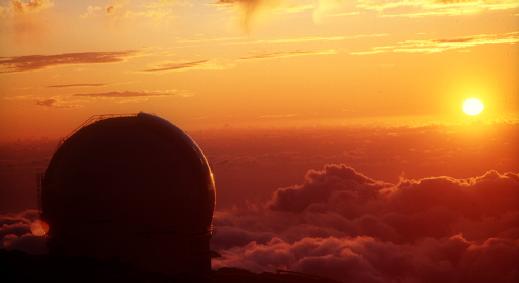
Sunset over the William Herschel Telescope (La Palma, Kingdom of spain; N. Szymanek)
Reading for this lecture:
- Study Guide 14 Bennett textbook Chapter 6
Reading for next lecture:
- Bennett textbook: pp. 203-204; Secs. 9.3, 9.5. Report Guide 15
Web Links:
- PBS Documentary: "400 Years of the Telescope" History of the telescope
More detailed notes on telescopes (Nick Strobel).
More than on telescopes and modern observational astronomy (ASTR 1230) Hubble Infinite Telescope
- HST Paradigm Gallery
Keck Observatory
ESO Very Large Telescope (VLT) National Radio Astronomy Observatory, Charlottesville More on detectors and astronomical color imaging (ASTR 1230) Technical introduction to CCDs in astronomy (ASTR 5110) Introduction to infinite astronomy (ASTR 5110)
Source: https://rwoconne.github.io/rwoclass/astr1210/guide14.html

Post a Comment for "What Is the Light-gathering Power of an 8-inch Telescope Compared to a 4-inch Telescope?"